Nuno Álvares Pereira
1360–1431. Constable of Portugal and the military commander behind the 1385 victory at Aljubarrota. Canonized in 2009.
"Pereira" is one of the most widely carried surnames in the Portuguese-speaking world, and one of the defining Catholic surnames of Goa. This page traces where the name came from, what it means, how it became part of Goan identity, and where it's carried today. It's the backdrop every Pereira shares — our own family's specific story is on the Family Tree page, as we gather it.
The name comes from the Portuguese and Galician word pereira, meaning "pear tree," rooted in the Latin pirum or pyrus (pear). Like most Portuguese surnames of its age, it began either as a topographic name — describing someone who lived near a notable pear tree or orchard — or as a habitational name, taken from one of several places in Portugal and Galicia actually called Pereira.
It's the same naming logic behind English surnames like Ashe or Underwood: a feature of the land became a name for the people tied to it.
The earliest records of the surname date to the 12th century, tied to a feudal estate near Barcelos in northern Portugal — by tradition, the Quinta de Pereira in Vermoim. Genealogical tradition credits Rodrigo Gonçalves de Pereira with founding the line, after receiving the estate for service to Henrique de Borgonha (Henry of Burgundy), Count of Portucale, in the early 1100s.
The name's most celebrated bearer is Nuno Álvares Pereira (1360–1431) — knighted at just 13, appointed Constable of Portugal soon after, and the military commander whose victory at the Battle of Aljubarrota in 1385 helped secure Portuguese independence from Castile. He was canonized by the Catholic Church in 2009 as Saint Nuno of Saint Mary.
The Pereira name reached Goa the way most Portuguese surnames did: through colonization and conversion. After the Portuguese conquest of Goa in 1510, the crown and the Catholic Church pursued an active campaign of Christianization. A 1567 decree from the Provincial Council of Goa went further still, prohibiting new converts from keeping their original names altogether.
In their place, converts typically took the surname of whoever stood as their godparent at baptism — a Portuguese priest, soldier, official, or landowner. That practice is why a relatively small set of Portuguese surnames — Pereira, Fernandes, Rodrigues, D'Souza, and a handful of others — became so concentrated across Goa, often clustering by village or parish depending on which Portuguese family had sponsored conversions there, particularly across Bardez and Salcete.
Worth knowing: taking a Portuguese surname changed a family's name and religion, but not, in most cases, their language or caste standing — converted families generally kept speaking Konkani and retained their social position within Goan society.
Pereira is the world's 90th most common surname — roughly 1 in every 1,093 people. Tap or click a point on the map.
Map: "Simple World Map" by Al MacDonald, ed. Fritz Lekschas — CC BY-SA 3.0. Markers are this site's own addition.
Or browse the list — each place shows roughly how the Pereira name settled there.
Spelling drifted as the name crossed languages and oceans. In Galicia and parts of Spanish-speaking Latin America it often appears as Pereyra or Perera. French-speaking descendants carry it as Pereire or, fully translated, Poirier ("pear tree" in French). In Sri Lanka, the closely related Perera is far more common than Pereira itself. Portuguese immigrants to parts of the United States — notably Massachusetts — frequently anglicized it to Perry.
Here's the part most "family crest" shops won't tell you: coats of arms were never granted to a surname. They were granted to individual people, and only their direct descendants had any right to use them. Two unrelated Pereiras in medieval Portugal were no more entitled to share a coat of arms than two strangers who happen to share a surname today.
With that said, several distinct Pereira lineages in Portugal were genuinely armigerous. One of the most commonly documented — associated with the Barcelos line described above — uses argent (silver/white) and gules (red), charged with a cross flory voided and martlets (small, footless birds). In heraldry, argent traditionally stands for peace and sincerity, gules for courage and valor, and martlets for speed of action — though, as with most heraldic "meanings," these interpretations were applied after the fact more often than they were a literal design brief.
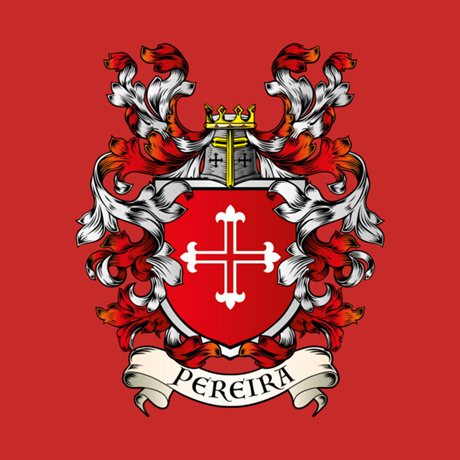
A crest and a coat of arms aren't technically the same thing, even though gift-shop mugs treat them interchangeably. The crest is specifically the small emblem mounted on top of the helmet above the shield — one piece of a complete coat of arms, not the whole thing. For the Barcelos Pereira line, heraldic sources commonly describe a crest built around the same martlet motif found on the shield itself.
As above: this belongs to one historically documented lineage, not to everyone who shares the surname today — including us, most likely. We list it here because it's part of the name's story, not because we're claiming it.
1360–1431. Constable of Portugal and the military commander behind the 1385 victory at Aljubarrota. Canonized in 2009.
c. 1460–1533. Portuguese explorer and author of Esmeraldo de Situ Orbis, an early navigational account of the West African coast.
1909–1985. American architect behind the Transamerica Pyramid and the Geisel Library at UC San Diego.
1699–1759. Portuguese-born financier of Sephardic descent who became a baron in 18th-century England.
Brazilian mixed martial artist and former UFC light heavyweight and middleweight champion.
American singer and internet personality, born Moriah Rose Pereira.
Roughly 1 in every 1,093 people in the world is named Pereira.
Pereira was widely adopted by Sephardic Jews of Portuguese origin as a "New Christian" surname, and spread throughout that diaspora.
The French surname Poirier and the Italian Piras both trace back to the same "pear tree" root as Pereira.
Like many Portuguese surnames, Pereira occasionally turns up as a given name too — a reversal that's become more common over the last century.
By the 18th century, Pereira was already well established across Goa — local histories describe Goan Pereira families active in village and church life across Bardez and Salcete, the same regions where the name first took root through the godparent naming practice described above. Today it remains one of the surnames most closely associated with the Goan Catholic community, both on the peninsula and across the diaspora that left Goa over the 19th and 20th centuries.
That's the story we're part of — and the one this whole site is, in its own small way, trying to keep adding to. If you know more about how our specific branch fits into it, get in touch — or have a look at what we've gathered so far on the Family Tree page.
Sources & further reading: Pereira (surname) — Wikipedia · Goan Catholic names and surnames — Wikipedia · Christianization of Goa — Wikipedia